

Storm Damage Roofing & Insurance Claims in Mount Vernon, OH
Storm damage roof inspections are available now throughout Mount Vernon and Knox County. If your roof took wind, hail, or impact damage in a recent storm, the documentation window for a strong insurance claim opens immediately and closes faster than most homeowners expect. Platinum Home Exteriors sends Amish crews from Millersburg to Mount Vernon for free emergency inspections, and every inspection produces a written damage report with photographs formatted for insurance submission.
Mount Vernon sits in Knox County within the NWS Cleveland severe weather corridor. Knox County has a documented history of significant tornado events, and the most recent is one that every homeowner in this market should understand. On June 14, 2022, NWS Cleveland confirmed an EF-1 tornado crossing from Morrow County into Knox County with top winds of 105 mph and a 7.1-mile path, dissipating between Fredericktown and Mount Vernon. The surrounding thunderstorm complex produced straight-line winds of 75 mph across the county outside the tornado path itself. Forty-six trees were toppled in Mount Vernon alone. More than 11,000 AEP customers in Knox County lost power. And critically, the tornado crossed into Knox County at approximately 11:30 p.m. at the same moment that 911 calls overwhelmed the dispatch center, so warning sirens in western Knox County never sounded before the storm arrived. By the time many residents knew a tornado had passed through their neighborhood, the roof damage had already been done with no official alert on record to establish when it happened.
Request a FREE Estimate
That warning gap matters for insurance claims. When a tornado arrives without a formal warning reaching your address, the documentation connecting any roof damage to a specific storm event depends entirely on the professional inspection you arrange in the days that follow. A second EF-0 tornado was confirmed in southeast Knox County in June 2024, and NWS issued a tornado watch covering Knox County in March 2026. The severe weather history in this market is real and recent. With approximately 43% of Mount Vernon's 7,211 occupied housing units built before 1950, and a median construction year of 1955, the housing stock most exposed to these storm events is also the stock where insurers most aggressively apply the pre-existing deterioration argument at claim time.
We Offer Financing Call Us For Details
Emergency Roof Inspection After a Storm — Call (330) 275-0935
Do not wait to see a leak before calling. The June 2022 Knox County storm is a concrete illustration of why timing matters. Residents in western Knox County had no warning the tornado was coming. When the storm passed, the wind had lifted shingles at fastener points, stressed chimney flashing, and in some cases compromised attic decking. None of it was visible from the ground, and none of it produced an interior stain for weeks or months. By the time a ceiling stain appeared, months had passed since the storm, and the insurer had ample grounds to argue the damage was ongoing deterioration rather than a specific event. The documentation window that existed in the days immediately after the storm had closed.
Platinum's inspection covers the full roof surface, every slope, all flashing transitions, every penetration, gutters, and downspouts. On Mount Vernon's older homes, particularly the 19th-century and early-20th-century stock in the downtown core and established residential neighborhoods, we pay close attention to chimney flashing condition, ridge cap attachment, and any soft spots in the underlying decking that indicate prior unaddressed water entry. The inspection produces a written damage assessment with photographs of all storm-related findings, formatted for insurance submission and in your hands before any claim is filed. When your adjuster schedules a property walk, a Platinum crew member attends. Adjusters covering Knox County after a widespread storm event move through a geographically spread caseload on a compressed schedule, and a contractor at the walk can identify damage that a fast ridge-level inspection will miss.
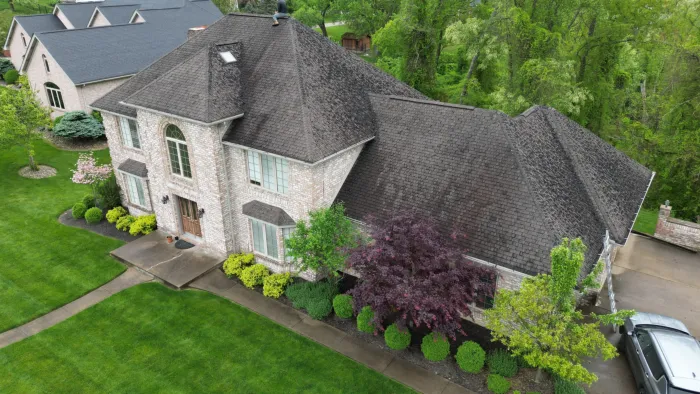
Wind damage indicators: Walk your property at ground level and look for missing or displaced shingles visible from the street, ridge cap sections that have shifted or separated, flashing pulled back at chimney bases or roof edges, and soffit or fascia panels that have loosened or detached.
Hail damage indicators: Check gutters and downspouts above lawn-mower height for dents, look for pockmarks on painted wood surfaces including window trim and fascia boards, inspect AC condenser fins for impact marks, and check downspout outlets for granule accumulation. These collateral signs confirm hail reached the roof surface before a close shingle inspection is possible.
Water intrusion indicators: Check attic sheathing and insulation for staining, dark spots, or soft areas. Look for water marks on top-floor ceilings or around light fixtures. In Mount Vernon's older housing stock, where solid board sheathing is standard beneath any asphalt layers added across replacement cycles, soft spots in the attic floor indicate water has been entering and the underlying decking is compromised. Any interior water sign after a storm warrants an immediate inspection call.
How Ohio Homeowners Insurance Covers Roof Storm Damage
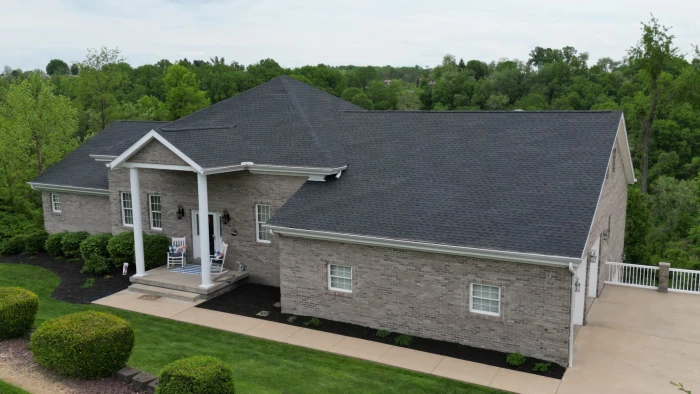
Most standard Ohio HO-3 policies cover sudden and accidental storm damage to the roof, including wind uplift, hail impact, falling trees and debris, and water intrusion caused by a storm-created opening. What those same policies exclude is damage that built up over time: wear and tear, granule loss from normal aging, deterioration from neglected maintenance, and pre-existing conditions present before the storm. In Mount Vernon, where the median home was built in 1955 and roughly four in ten occupied units predate 1950, pre-existing deterioration is a standard point of scrutiny when an adjuster reviews a claim on this housing stock. Platinum's inspection documentation is what establishes the pre-storm condition in writing and keeps your claim on the right side of that review from the start.
ACV vs. RCV: What Your Policy Actually Pays
Knowing which type of policy you carry before a storm changes how you evaluate every settlement offer. An Actual Cash Value (ACV) policy pays the depreciated value of your roof at the time of the claim. If a full roof replacement on your Mount Vernon home costs $13,000 and your asphalt roof is 20 years old, an ACV policy might release $4,500 after depreciation, leaving you to cover $8,500 out of pocket regardless of what the storm caused. A Replacement Cost Value (RCV) policy covers the full replacement cost minus your deductible, regardless of the roof's age. With a $2,000 deductible on the same $13,000 job, an RCV policy pays $11,000 and your only out-of-pocket cost is the deductible. RCV policies release payment in two stages: an initial check for the depreciated value, then a second check for the held-back depreciation once you submit proof of completed repairs. Ohio insurers have been converting aging roofs from RCV to ACV coverage quietly at renewal, and with Mount Vernon's median housing construction year of 1955, a significant share of local roofs are already in the age range where that conversion is most likely. Checking your declarations page before storm season is the only reliable way to know what your policy will actually pay.
What Ohio Insurers Are Likely to Deny
Claims on Mount Vernon roofs that show pre-existing deterioration carry elevated denial risk because adjusters can argue that storm damage accelerated conditions that already existed rather than causing them. On the 19th and early-20th century structures throughout the downtown core and established residential neighborhoods, original or early-replacement chimney flashing, aged ridge cap, granule-depleted shingle surfaces, and wood deterioration at penetration points give insurers multiple angles to challenge a claim. Unrepaired prior claims, where a previous damage event was settled but repairs were never completed, give adjusters grounds to reject new claims on the same area. Policy exclusions for gradual water damage can also reduce coverage when a water entry path pre-dated the storm. Platinum's written inspection report documents the condition of every roof section, identifies storm-specific damage indicators separate from pre-existing wear, and produces a dated photographic record that establishes what the storm caused and what the roof's pre-storm condition was.
The Platinum Storm Damage Claim Process
Emergency Inspection
Step 1: Emergency Inspection. A Platinum crew member travels to your Mount Vernon home for a complete roof inspection covering every slope, all flashing transitions, gutters, downspouts, and any accessible attic sheathing. On older properties with original chimney profiles and irregular roof plane changes, the crew takes additional measurements at every transition point. Every finding is photographed and recorded in a written damage assessment tied to the storm date. This report is produced and delivered before any claim is filed.
File Your Claim
Step 2: File Your Claim. Contact your insurance company and report the storm damage. You will receive a claim number and be assigned an adjuster. Provide your insurer with the Platinum inspection report at this stage. Claims filed with supporting contractor documentation move faster and are less likely to be minimized at first contact with your carrier.
Review the Scope of Work
Step 3: Adjuster Walk — Platinum Is There. Request that a Platinum crew member be present when your adjuster inspects the property. Adjusters covering Knox County after a widespread storm event work through a geographically spread caseload on a compressed schedule. A contractor at the walk can direct the adjuster to wind-lifted shingle sections, hail impacts on lower slopes, flashing separations at chimney transitions, and attic deck damage that a fast inspection from the ridge alone will not catch.
Review the Scope of Work
Step 4: Review the Scope of Work. After the adjuster's visit, your insurer will issue a written scope of work document listing what they will cover. Review that scope against Platinum's estimate before agreeing to anything. On Mount Vernon's older homes, scopes frequently omit on-site fabricated flashing required at chimney and penetration transitions, deck board repairs revealed at tear-off, and code-required upgrades that apply when a full tear-off is performed under current Ohio Building Code. Your contractor can request a supplement to address omitted line items before work begins.
Deductible and Start of Work
Step 5: Deductible and Start of Work. Once the claim is approved and the scope reviewed, you pay your deductible and work begins. Platinum does not require full payment before the job starts. The approved insurance proceeds cover the agreed scope, and any upgrades you choose beyond the claim are settled separately in writing before installation.
Emergency Inspection
Step 6: Final Documentation and Second Check. After the job is complete, Platinum provides all documentation your insurer needs to release any held-back depreciation on an RCV policy. That second check is not automatic. It requires submitted proof of completed work, and we handle that paperwork as part of every job close-out.
Why Metal Roofing Is the Right Answer After a Storm Claim in Mount Vernon
A storm insurance claim is the moment when many Mount Vernon homeowners make the roof decision they have been deferring. The claim covers the cost of a like-for-like replacement, and the only out-of-pocket cost is the deductible. That is also the moment when replacing asphalt with standing seam steel makes the most financial sense: the deductible is fixed regardless of which system goes on, and the incremental difference to upgrade is the only variable in the decision. In a county that has seen confirmed tornado events in 2022 and 2024, with insurance premiums rising 36.4% since 2019, the case for ending the asphalt replacement cycle entirely is at its clearest when a funded replacement is already underway.
Class 4 Hail Certification and Ohio Insurance Premiums
Standing seam metal roofing installed by Platinum carries Class 4 UL 2218 impact resistance, the highest hail certification available. Many Ohio insurance carriers offer a premium reduction for Class 4 certified roofing, and that discount carries more financial weight now than it did five years ago. Ohio homeowners saw a 10.9% premium increase in 2024 alone, and premiums have climbed 36.4% statewide since 2019. A Class 4 certified roof is one of the few home-level decisions that directly offsets rising premium costs, and a standing seam installation holds that certification for the full 40-to-60-year service life rather than requiring recertification after each asphalt replacement cycle. Mount Vernon homeowners replacing a storm-damaged roof should ask their agent specifically about Class 4 discounts before the next renewal.
Concealed Fasteners and Knox County Wind Exposure
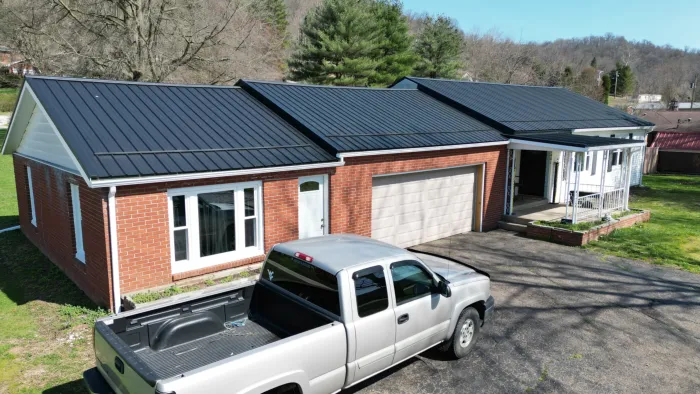
The failure mode behind most wind damage claims on asphalt roofing is exposed fastener back-out. Freeze-thaw cycling works on deck connections over time, and the full thermal range across a Knox County year stresses fastener attachment through repeated expansion and contraction. As fasteners back out incrementally, the seal at each attachment point weakens. The 75 mph straight-line winds documented across Knox County outside the June 2022 tornado path found those compromised points and lifted shingles from below across the full residential footprint of the county, not just the 7.1-mile tornado track itself. Standing seam's concealed floating-clip system has no exposed fasteners on the panel face. Each clip allows thermal movement without stressing the seam, and wind uplift load distributes across the full panel length rather than concentrating at individual fastener points.
One Roof, Not Three
A properly installed standing seam roof in the Ohio Valley reaches a 40-to-60-year service life. The asphalt system being replaced through a storm claim typically delivered 20 to 25 years, and often less when storm events accelerated granule loss in the final years of service. With Mount Vernon's median construction year of 1955, many of the city's owner-occupied properties have already been through one or two complete asphalt replacement cycles on the same structure. Replacing asphalt with asphalt after a claim resets that clock and returns the homeowner to the same decision in another 20 years, through two or three more Knox County storm seasons. Replacing asphalt with standing seam ends that cycle entirely.
What Our Customers Say
EXCELLENTTrustindex verifies that the original source of the review is Google. Steve and his guys were fantastic!! The job was done in a timely manner and the site was kept clean and free of debris. They are very professional and very easy to work with!!Posted onTrustindex verifies that the original source of the review is Google. Very satisfied with Platinum Exteriors work. Was quick and good prices. Highly recommend.Posted onTrustindex verifies that the original source of the review is Google. What a GREAT COMPANY...DID A GREAt job...workers are great,,,not a thing left behind...Posted onTrustindex verifies that the original source of the review is Google. Platinum Home Exteriors was very easy to work with. I made phone calls to 4 other contractors and Steven was the only one to return my call. He thoroughly explained our options. He was very polite and professional. His crew completed the job in one day. They did an excellent job. You can’t go wrong with Platinum!Posted onTrustindex verifies that the original source of the review is Google. Steve Yoder and his crew did a fantastic job of installing our new roof. Their price quote was 25% lower than my other bids and the work was absolutely stellar. They arrived on time , covered the shrubs, moved the outdoor furniture, and planters. When the job was done ,which took them 3 hours and 45 minutes , they returned all the plants and furniture to their place and even ran a magnet over the yard and driveway to make sure all the nails were picked up Cannot say enough good things about this crew. Great people and great job at a very fair price. Highly RecommendPosted onTrustindex verifies that the original source of the review is Google. Steve and his crew are probably the best you can find for roofing very professional and they get the job done asap l couldn’t have found anyone betterPosted onTrustindex verifies that the original source of the review is Google. Steve was very nice young man. Very polite and easy to talk with. Was very willing to help and figure out best way to accomplish the task. Very effeicient and quick to get the work completed. If any issues arise he will work with you to fixed the problem. His work was excellent and it was excatly what I was wanting. I will call him in the future for any other projects I will need to have done,Posted onTrustindex verifies that the original source of the review is Google. So great to work with. Beautiful craftsmanship, clean worksite, solid communications. Really appreciate their care & attitude to timely completion of wonderful new roof & guttersPosted onTrustindex verifies that the original source of the review is Google. Platinum Home Exteriors is awesome. Showed up early and finished our large roof in 8 hours! Cleaned up everything like they were never here, in addition they have very competitive pricing. Steve Yoder is a great guy to deal with.Posted onTrustindex verifies that the original source of the review is Google. These guys arrived at 6:30am and had my new roof on and headed home at 4:00pm. They did a wonderful job and cleaned up all the trash and took it with them. They’re hard workers and don’t waste time getting the job done. I love my new roof and it’s made a big difference in heating and cooling my house along with reducing outside noise. I give this company a 5 out of 5 and recommend them to anyone who is looking to replace their existing roof.
The Storm Chaser Problem in Knox County
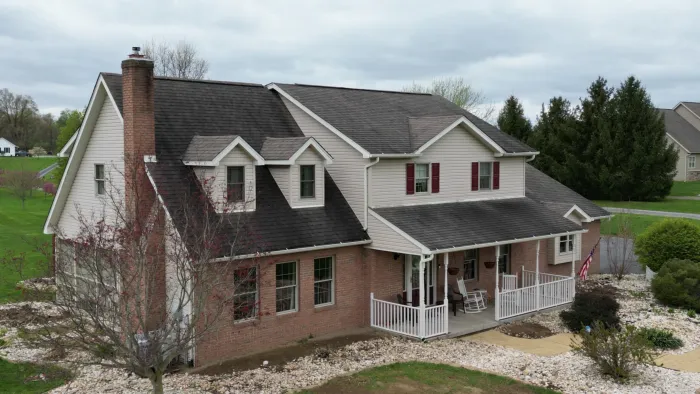
After every significant storm event in central Ohio, out-of-state and out-of-county contractors move into affected communities in the days that follow, offering fast inspections and same-week turnarounds. These operations are not established local contractors. Ohio's Attorney General consistently ranks home improvement fraud among the top consumer complaint categories in the state, and storm-chasing roofing operations targeting Ohio homeowners after weather events have been the subject of multiple enforcement actions in recent years. The pattern is consistent: an unscrupulous contractor solicits work door-to-door in the days following a storm, collects a large deposit or asks the homeowner to sign over an insurance check, performs little or no work, and is unreachable once installation failures appear after a full seasonal weather cycle. By the time problems surface, the operation has moved on to the next storm market, reorganized under a new name, or dissolved entirely.
Platinum Home Exteriors is based in Millersburg, Tuscarawas County, and serves central Ohio including Knox County. Our Amish crews are local tradespeople who have worked in this region for years and are not following the storm. The crew that inspects your roof is the crew that installs it, with no subcontracting and no handoff at any stage. Every installation carries the Industry Leading Craftsmanship Warranty on all labor and workmanship, a warranty that only means something when the contractor is still operating and reachable when you need it. We are.
Request a Free Estimate
Mount Vernon Frequently Asked Roofing Questions
Q:Will my insurance cover storm roof damage in Mount Vernon?
Q:What is the difference between ACV and RCV insurance?
Q:How long do I have to file a claim after a storm in Ohio?
Q:Does metal roofing help with insurance premiums in Ohio?
Q:How do I spot storm damage on my Mount Vernon roof after a severe weather event?
Q:Why do Mount Vernon homeowners choose Platinum's Amish crews for storm damage work?
Schedule an Emergency Roof Inspection in Mount Vernon, OH
The June 2022 EF-1 tornado dissipated between Fredericktown and Mount Vernon. Many of the Knox County residents whose roofs it damaged never heard a warning before it arrived. The documentation window for tying that damage to a specific storm event was open for days, not months, and every homeowner who acted immediately had a stronger claim than every homeowner who waited. The same dynamic applies to every significant weather event in this corridor. Every day after a storm that passes without a professional inspection is a day the documentation narrows and secondary damage compounds.
Platinum Home Exteriors serves Mount Vernon and the surrounding Knox County area with emergency storm damage inspections. From Millersburg, our Amish crews reach Fredericktown, Gambier, Centerburg, Danville, Howard, and Apple Valley for free in-person inspections throughout the service area. Every inspection is free. Every damage report is written and photographed. Every crew member is available to attend your adjuster walk. Call (330) 275-0935 to schedule, and see all Mount Vernon roofing services See our Mount Vernon, OH Page. or See our Ohio page. for the full Ohio service area.